


START
END

DURATION
8 weeks
8 weeks

HOURS OF EFFORT
8-10 Hours of Effort per Week
8-10 Hours of Effort per Week

LANGUAGE
English
English

FORMAT
Online
Online

PRICE
This course is part of our Professional Certificate Program in Digital Transformation in the AI Age, Blended Professional Certificate Product Management, Blended Professional Certificate: Chief Product Officer, Blended Professional Certificate: Chief Technology Officer and Blended Professional Certificate: Chief Digital Officer
Overview: Applied Agentic AI for Organizational Transformation
The Applied Agentic AI for Organizational Transformation course from MIT Professional Education equips leaders with the knowledge, frameworks, and practical tools to harness agentic AI for enterprise transformation. Participants explore how autonomous AI agents can enhance decision-making, automate complex workflows, and drive innovation across the enterprise.
Through practical applications and AI tools, the course helps participants identify high-impact AI opportunities, develop implementation strategies, and lead AI adoption responsibly. By the end of the course, participants are prepared to leverage agentic AI as a strategic enabler of business growth, operational efficiency, and competitive advantage.
59%
Of hiring managers say the rise of AI will have a substantial or transformational impact on the types of skills their companies need.
Source: Salesforce
71%
Of organizations regularly use Generative AI in at least one business function
Source: Hostinger
77%
Of executives agree that AI agents will reshape how digital systems are built, and believe digital ecosystems must be designed for agents as much as humans.
Source: Accenture
What Will you Learn in the Applied Agentic AI for Organizational Transformation Course?
Module 1: Foundations of Generative and Agentic AI
- Evaluate the strategic value of AI functionalities such as chatbots, reasoning, and multimedia.
- Construct an evaluation of the cost of an AI system.
- Distinguish between major AI model types and terminology.
Module 2: The Rise of Agentic AI and Emerging AI Platforms
- Explain the most relevant AI platform or approach for a specific sector and its application to agentic AI use cases.
- Evaluate the key factors influencing the selection of open-source versus proprietary AI platforms within a specific organizational context.
- Develop a landing page using AI.
- Prompt AI to create a visual mock-up and functional HTML code.
- Activate the code by saving and reuploading it.
- Explain a new AI workflow within an organization.
Module 3: Connecting Agents to Digital Ecosystems
- Construct a use case demonstrating agent-based interaction across integrated tools.
- Write a structured email-style proposal that outlines a specific use case for an AI agent within an organizational context.
- Analyze a business workflow to determine how an AI agent could improve efficiency, reduce costs, or enhance user experience.
- Design an integration approach that specifies how the proposed agent would connect with existing systems, platforms, or application programming interfaces (APIs).
- Evaluate the potential risks, ethical considerations, and success metrics associated with deploying the proposed AI agent.
Module 4: Cybersecurity: Classic Scenarios, Agent Risks, Disinformation, and Systemic Impact
- Analyze organizational AI systems and workflows to identify potential cybersecurity risks using the National Institute of Standards and Technology (NIST) Cybersecurity Framework categories.
- Evaluate current security practices to identify gaps in access control, monitoring, response, and recovery capabilities.
- Develop a structured AI risk and security plan, including stakeholders, training, and incident response procedures.
- Recommend actions to improve organizational readiness across identify, protect, detect, respond, and recover domains.
- Analyze organizational AI systems and workflows to identify potential cybersecurity risks.
- Evaluate how accountability is defined and enforced alongside security practices and governance in AI systems.
Module 5: AI Agents by Business Function
- Describe the organizational context, including industry, organization type, and department, relevant to a proposed AI-driven product design initiative.
- Summarize the current product design workflow within an organization to establish a baseline for improvement.
- Select an appropriate AI technology for integration into a product design process based on its capabilities and relevance.
- Develop a structured plan outlining how AI can be integrated into a product design workflow to improve efficiency, effectiveness, or quality.
- Identify an appropriate AI agent architecture for a given organizational context and explain key trade-offs.
- Identify opportunities for AI-enabled BPO and describe their potential organizational impact.
Module 6: The Last Mile—From Pilot to Practice
- Propose measurable key performance indicators (KPIs) that evaluate the effectiveness of an AI sstem in relation to business outcomes.
- Describe the organizational context, including sector, organization type, and department, relevant to an AI implementation.
- Summarize the purpose and functionality of a proposed AI system within a business workflow.
- Write three to five key performance indicators (KPIs) that measure the effectiveness of an AI implementation.
- Evaluate how the selected KPIs align with business goals and indicate whether the AI system is achieving its intended outcomes.
Module 7: Governance, Compliance, and Agent Testing
- Identify applicable regulatory frameworks (e.g., GDPR, CCPA, HIPAA) relevant to a specific AI use case.
- Analyze the risks associated with deploying AI systems, including both compliance and operational risks.
- Apply appropriate testing strategies (e.g., sandboxing, A/B testing, safety checks) to evaluate AI system behavior.
- Develop a comprehensive AI governance plan that integrates regulations, testing, risk mitigation, and documentation practices.
- Create guiding questions that identify key regulatory and implementation considerations in real-world AI healthcare scenarios.
- Classify AI use cases using the Risk–Speed Quadrant Framework.
Module 8: Ethics and Capstone
- Explain how AI can be strategically integrated into organizational functions to create business value.
- Evaluate the suitability of AI technologies for specific organizational use cases.
- Analyze the cost, security, and operational implications of AI adoption.
- Assess the human and organizational factors that influence successful AI implementation.
- Synthesize course concepts into a structured approach for organizational AI adoption.
- Evaluate ethical risks in a proposed AI system by identifying a potential issue, assessing its business impact, and recommending an appropriate mitigation strategy.
Capstone Project
In this course, apply your learning in a final capstone project designed to demonstrate real-world impact. Choose between two strategic paths:
- Design a comprehensive AI integration plan tailored to a specific business function
- Develop an executive presentation that outlines a transformative, agent-based AI initiative.
Support your project with a detailed risk-benefit analysis, cost implications, and measurable KPIs to demonstrate strategic value.
AI Applications Taught in the Course

Agentic AI
Learn how autonomous AI agents can make decisions, execute tasks, and automate workflows to improve productivity and business performance.

Generative AI
Explore how Generative AI creates text, images, audio, and other content, and how it can be applied across business functions

AI-Integrated Strategies
Discover how to integrate AI into organizational strategy, operations, and enterprise systems using cloud infrastructure, APIs, and emerging AI platforms.

AI Ethics
Examine key ethical, legal, and governance considerations, including bias, privacy, compliance, misinformation, and responsible AI adoption.
In just eight weeks, participants gain practical insights into how Generative and Agentic AI are transforming industries. They also learn how to apply these technologies across organizational strategy, operations, and governance.
What Skills Will You Learn in this Agentic AI Course?
1.
Lead with Confidence in the Age of AI: Understand the strategic implications of Generative and Agentic AI, and how to integrate them into your business models, customer journeys, and operations.
2.
Understand the Tools of Transformation: Gain hands-on experience with platforms such as ChatGPT and Ollama, and learn how to evaluate, prototype, and deploy AI-powered solutions.
3.
Drive Responsible Innovation: Develop a clear understanding of AI ethics, bias mitigation, compliance frameworks (such as GDPR and HIPAA), and governance best practices.
4.
Communicate AI Value Across the Organization: Learn to articulate AI’s business potential in clear, actionable language that engages stakeholders across functions.
5.
Deliver a Strategic AI Roadmap: Develop an executive-ready AI adoption plan or strategic presentation tailored to your organization’s needs.
Why Choose the MIT Professional Education
Applied Agentic AI Course?
Build a Foundation in Agentic AI
Understand the building blocks of generative and agentic AI, including how they differ, how they work, and what business functions they can transform.
Develop Enterprise AI Strategies
Design AI-integrated digital strategies using cloud, APIs, and enterprise systems to deploy real-world solutions.
Gain Hands-On AI Experience
Apply AI through mini-projects and gain hands-on experience generating images, audio, text, or video in business contexts.
Lead Responsible AI Adoption
Plan for ethical considerations, legal compliance, as well as addressing risks like deepfakes, misinformation, and prompt injection with sound governance strategy.
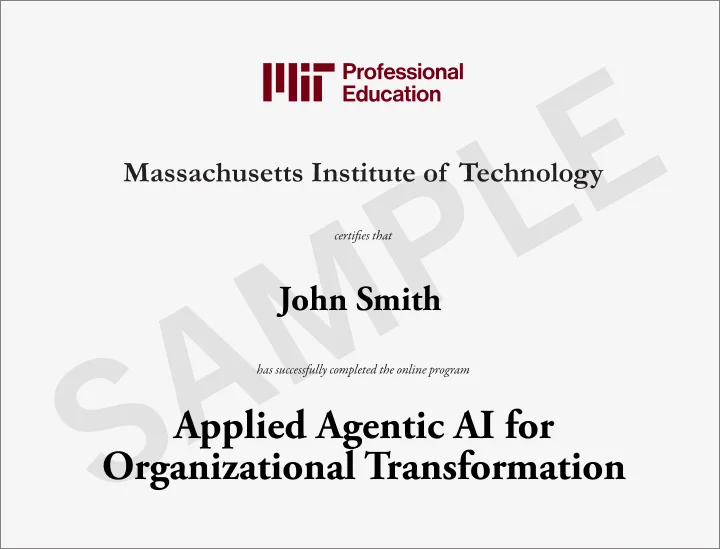
Course Credential: Certificate of Completion
Participants who complete the Applied Agentic AI for Organizational Transformation course receive an MIT Professional Education Certificate of Completion and MIT Continuing Education Units (CEUs).
To obtain CEUs, complete the accreditation confirmation, which is available at the end of the course. CEUs are calculated for each course based on the number of learning hours.
*The Continuing Education Unit (CEU) is defined as 10 contact hours of ongoing learning and indicates the amount of time devoted to a non-credit, non-degree professional development program.
To understand whether or not these CEUs may be applied toward professional certification, licensing requirements, or other required training or continuing education hours, please consult your training department or licensing authority directly.
Who Should Attend the Applied Agentic AI for Organizational Transformation Course?
This course is designed for leaders who want to adopt AI and drive meaningful change across their organizations. Whether you lead strategy, manage transformation, or advise clients, this course helps you turn AI ideas into measurable business results.
Participants who can enroll include:
- C-suite executives (CEOs, CIOs, CTOs, CMOs, COOs) aiming to make informed decisions about AI strategy and integration
- Business leaders and function heads driving digital innovation in operations, marketing, product, or strategy
- Managers and team leads modernizing workflows and aligning cross-functional teams with emerging technologies
- Technical professionals moving into leadership roles in digital transformation or innovation
- Consultants and advisors supporting clients through AI-driven change and adoption planning
What Do Past Participants Have to Say?

ALENA SLETTEN
Senior Director of Delivery Management, EPAM Systems
In a modern world it’s difficult to stay on the top of all of the latest trends, understand the idea behind them and their practical applications. This course helped me to systematize my knowledge, covered the gaps that I had and allowed me to look at things from different angle.
Applied Agentic AI for Organizational Transformation
Meet the Course Instructors

Professor John R. Williams’ research focuses on the development and application of computing algorithms in distributed cyberphysical systems. He was director of the Auto-ID Laboratory, where the Internet of Things was invented. He is considered, along with Bill Gates and Larry Ellison, one of the 50 most powerful people in “Computer Networks”.
He is author and coauthor of more than 250 articles in journals and conferences. Professor Williams teaches courses on the basics of programming, modern software development, the architecture of web, cloud and blockchain systems. In addition, he holds a BSc in Physics from Oxford University, an MSc in Physics from UCLA, and a PhD from the University of Swansea.

Dr. Sanchez is the architect of the global network “The Internet of Things” and data analysis platforms for SAP, Ford, Johnson & Johnson, Accenture, Shell, Exxon Mobil and Altria. In cyber security, he has developed cyber-attack impact analyses for the U.S. Department of Defense and a password firewall for the IARPA.
Dr. Abel Sanchez holds a PhD from the Massachusetts Institute of Technology (MIT) and teaches MIT courses in cyber security, engineering, blockchain and data science. He has been involved in developing educational software for Microsoft and establishing the Accenture Technology Academy. He has produced over 150 educational videos, has 10 years of experience with learning management systems and has made deployments in the Americas, Asia and Europe.
FAQs
1. What is MIT Professional Education’s Agentic AI course about?
The Applied Agentic AI for Organizational Transformation course from MIT Professional Education helps leaders understand and apply Generative AI and Agentic AI to drive business transformation. Participants learn to integrate AI into strategy, operations, workflows, and governance.
2. Is the Applied Agentic AI course from MIT Professional Education worth it?
Yes. The course is designed for professionals leading AI adoption, digital transformation, and innovation initiatives. It focuses on practical business applications, AI strategy, governance, and implementation, with no programming background required.
3. What is the time commitment of the course?
The course is eight weeks long, fully online, and requires approximately eight to ten hours per week. It includes eight modules, two live webinars with MIT instructors, and weekly facilitator support.
4. Does the course offer a certificate?
Yes. Participants who successfully complete the course receive an MIT Professional Education Certificate of Completion and MIT Continuing Education Units (CEUs).
5. What is the best agentic AI course?
The Applied Agentic AI for Organizational Transformation course is a strong choice for leaders seeking to understand and implement Agentic AI. It combines AI strategy, autonomous agents, enterprise integration, governance, and change management in a single executive-focused learning experience.