

START

DURATION
9-12 months
9-12 months

HOURS OF EFFORT
8-10 Hours of Effort per Week
8-10 Hours of Effort per Week

LANGUAGE
English
English

FORMAT
Online
Online

PRICE
APPLICATION FEE
This course is also part of our Professional Certificate Course in Sustainability and Blended Professional Certificate: Chief Sustainability Officer Program.
Overview – Sustainability Program: Strategies and Opportunities for Industry
The Sustainability: Strategies and Opportunities for Industry program from MIT Professional Education equips professionals with the knowledge, frameworks, and tools needed to address complex sustainability challenges and create meaningful organizational impact. Participants explore how environmental, social, and economic considerations intersect with business strategy and learn how to translate sustainability goals into practical action.
Through interdisciplinary perspectives, real-world case studies, and industry applications, this sustainability program by MIT Professional Education helps participants evaluate sustainability opportunities, measure environmental impact, develop sustainable business practices, and contribute to organizational transformation.
By the end of this sustainability program, participants will be prepared to support sustainability initiatives, contribute to ESG-focused decision-making, and develop strategies that balance business performance with environmental responsibility.
84% of consumers say they try to shop at companies that support causes they care about.
Source: World Economic Forum.
4.2 million premature deaths were linked to air pollution globally.
Source: United Nations.
Renewable energy represented only 17% of total energy consumption.
Source: United Nations.
What will You Learn in the Sustainability:
Strategies and Opportunities for Industry Program?
Course 1: Sustainability: Strategies and Opportunities for Industry
-
Understand the fundamentals of sustainability
-
Analyze materials, energy, and resource flows (Part I)
-
Examine materials, energy systems, and environmental impact (Part II)
-
Explore sustainable products and consumption models
-
Assess cities, resources, and the global economy
-
Evaluate ethics and responsibility in sustainability
-
Identify global opportunities in the Anthropocene
-
Understand sustainable development and global transition frameworks
Course 2: Sustainable Infrastructure Systems: Planning and Operations
-
Understand systems theory and core concepts
-
Explore sustainability in infrastructure systems
-
Apply multi-objective decision analysis to infrastructure planning
-
Evaluate uncertainty using decision trees
-
Map system interactions and dynamics
-
Define metrics for monitoring and measurement
-
Build adaptability in complex systems
-
Analyze real-world systems through case studies
Course 3: Life Cycle Assessment: Quantifying Environmental Impacts
-
Understand life cycle assessment concepts and tools
-
Define goal and scope for LCA studies
-
Conduct life cycle inventory analysis
-
Evaluate impacts through life cycle impact assessment
-
Interpret results to support decision-making
-
Apply LCA through real-world case studies
Course 4: Circular Economy: Transition for Future Sustainability
-
Understand the circular economy concept and its strategic vision
-
Apply material and energy strategies for circular systems
-
Examine the link between climate change and circularity
-
Analyze natural capital and environmental accounting frameworks
-
Explore waste-to-resource recovery systems
-
Evaluate technologies for recycling and material reuse
-
Model circular economy systems and dynamics
-
Assess economic principles driving circularity
-
Address measurement gaps in circular economy implementation
Course 5: Clean Energy Solutions: Technological Change to Meet Emissions Reduction Targets
-
Introduction to clean energy fundamentals and global energy systems
-
Emissions scenarios and climate change impact analysis
-
Evaluation methods for energy systems and sustainability performance
-
Technology change trajectories shaping the future of energy
-
Investment models for clean energy and climate solutions
-
Energy and climate change policy frameworks and governance
Sustainability Applications Taught in the Program
The Sustainability: Strategies and Opportunities for Industry program from MIT Professional Education helps participants understand how sustainability can be embedded into business strategy, operations, governance, and innovation.

Sustainable Business Strategy
Learn how organizations develop and implement sustainability initiatives that drive business value, strengthen resilience, and support long-term growth.

ESG and Sustainable Governance
Explore environmental, social, and governance frameworks that help organizations manage risk, meet stakeholder expectations, and support responsible decision-making.

Sustainability Measurement and Reporting
Understand how sustainability performance is measured using industry-recognized metrics, frameworks, and assessment tools.

Circular Economy and Resource Efficiency
Examine strategies that reduce waste, improve resource utilization, and create more sustainable production and consumption models.

Industry Sustainability Transformation
Discover how different industries are responding to sustainability challenges through innovation, technology adoption, operational improvements, and sustainable business practices.
In just eight weeks, participants will gain a practical understanding of sustainability principles, ESG frameworks, and sustainable business transformation strategies, enabling them to contribute to organizational sustainability goals and drive meaningful change.
LEARN MORE ABOUT THE PROGRAM SPECIFICS
What Skills Will You Develop in This MIT Professional Education Sustainability Program?
1.
Lead Sustainability Initiatives With Strategic Confidence
Understand the business implications of sustainability and support initiatives that align environmental goals with organizational priorities.
2.
Build Sustainable Business Strategies
Learn frameworks to identify sustainability opportunities, manage risks, and create long-term business value through sustainable practices.
3.
Measure Sustainability Performance
Develop the ability to evaluate sustainability outcomes using key metrics, indicators, and assessment frameworks.
4.
Apply ESG Principles Across the Organization
Understand how environmental, social, and governance (ESG) considerations influence strategy, risk management, and stakeholder engagement.
5.
Drive Sustainable Transformation Across Industries
Explore how different sectors are addressing sustainability challenges and implementing innovative solutions to improve performance.
6.
Develop Practical Sustainability Solutions
Learn to formulate policies and actionable strategies that address sustainability challenges while supporting business objectives.
7.
Strengthen Data-Driven Decision-Making
Use sustainability data and insights to support informed decision-making and improve organizational outcomes.
8.
Create Organizational Impact Through Sustainability
Build the knowledge and confidence to contribute to sustainability initiatives that drive measurable environmental and business results.
Why Choose the MIT Professional Education Sustainability Program?
Build a Foundation in Sustainability
Develop a comprehensive understanding of sustainability principles, environmental challenges, and their implications for modern organizations.
Develop Sustainable Business Strategies
Learn how to align sustainability goals with business objectives and create practical strategies that support long-term organizational success.
Gain Industry-Relevant Insights
Explore real-world sustainability challenges and opportunities across industries including manufacturing, finance, consumer goods, technology, healthcare, and energy.
Understand ESG and Governance Frameworks
Examine ESG principles, sustainability policies, reporting considerations, and governance practices that influence business decision-making.
Measure Sustainability Impact
Learn how sustainability performance is assessed through metrics, indicators, and analytical frameworks that support data-driven decisions.
Drive Organizational Transformation
Develop the knowledge needed to support sustainability initiatives, influence stakeholders, and contribute to sustainable business transformation.
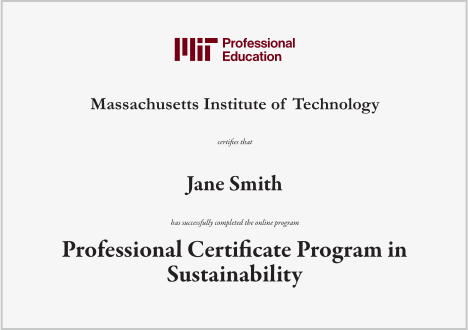
Program Credential: Certificate of Completion
Participants who successfully complete the Sustainability: Strategies and Opportunities for Industry course receive an MIT Professional Education Certificate of Completion and MIT Continuing Education Units (CEUs).
To obtain CEUs, participants must complete the accreditation confirmation available at the end of the course. CEUs are awarded based on the total number of learning hours completed.
*The Continuing Education Unit (CEU) is defined as 10 contact hours of ongoing learning and indicates the amount of time devoted to a non-credit, non-degree professional development program.
To understand whether or not these CEUs may be applied toward professional certification, licensing requirements, or other required training or continuing education hours, please consult your training department or licensing authority directly.
Benefits of Joining the Professional Alumni Community
MIT Professional Education offers a number of benefits for participants who successfully complete our Professional Certificate Programs:
- Digital Professional Certificate and MIT CEUs*.
- 15% benefit for online programs and short-duration, in-person programs offered by MIT Professional Education.
- 20% benefit for all DPP programs
- Invitation to a Certificate Award Ceremony at MIT’s campus in Cambridge, Massachusetts, where participants will receive a physical certificate.
- Access to the virtual campus for 2 years after program completion.
- Exclusive announcements of new courses, programs, and events.
- Exclusive access to the MIT Professional Education Alumni LinkedIn group, connecting you with a global network of fellow MIT Professional Education alumni.
Who Should Enroll in the Sustainability Program?
This sustainability program is designed for professionals seeking to address sustainability challenges, uncover business opportunities, and drive organizational transformation.
Participants who can benefit include:
- Corporate and strategic decision-makers determined to make an impact in their organizations
- Technical experts with a strong interest in sustainable business operations
- C-suite, managers, and other high-level professionals from any sector who oversee teams and are interested in implementing new strategies to enhance their business’s sustainability
- Data analysts, scientists, and engineers interested in achieving data-driven, sustainable outcomes.
- Professionals who want to implement sustainable practices in their industry.
In addition, professionals in the fields of marketing, sales, business development, market analysis, consulting, policy, and entrepreneurship will also benefit from the resources offered in this course.
We recommend that functional and multifunctional teams participate in the course together to accelerate the adoption of sustainable practices.
Who is the Instructor of the Sustainability Program?
Listed in alphabetical order
Professor of Building Technology Program in the Department of Architecture in MIT and Director of MIT Environmental Solutions Initiative
Professor Fernández is first and foremost a practicing architect who has designed more than 2.5 million square feet of new construction in major cities around the world including New York City, Tokyo, and Shanghai.
His work in sustainability began with research regarding materials for high performance buildings, low energy residence, and urbanization.
• He founded the MIT Urban Metabolism Group to focus his research on the resource intensity of cities as well as on design and technology pathways for future urbanization, taking part in projects across four continents.
• He is a member of more than 15 organizations, the most prestigious of which being his role on the Board of Directors of the Building Envelope Technology and Environmental Council of the National Institute of Building Science; New Ecology, Inc; and the Center for Sustainable Energy of the Fraunhofer Institute.
• He is also a proud author of two books and numerous articles in scientific and design journals, as well as a speaker for conferences and symposia around the world.

Jeremy Gregory is the Executive Director of the MIT Climate and Sustainability Consortium. He studies the economic and environmental implications of engineering and system design decisions, particularly in materials production and recovery systems.
Research topics include product and firm environmental foot-printing, manufacturing and life-cycle cost analysis, and characterization of sustainable material systems. He has applied these methods, often with industry partners, to a range of products and industries, including pavements, buildings, automobiles, electronics, consumer goods, and waste treatment and recovery. Gregory earned a BS in mechanical engineering from Montana State University, and an MS and PhD in mechanical engineering from MIT.

Elsa Olivetti’s research spans three levels of materials production: operational-level, industrial network-level and market-level strategies. Olivetti’s research focuses on improving the environmental and economic sustainability of materials in the context of rapid-expanding global demand.
Furthermore, Olivetti’s research addresses improving the sustainability of materials through increased use of recycled and renewable materials, recycling-friendly material design, and intelligent waste disposition and understanding the implications of substitution, dematerialization, and waste mining on materials markets.
Furthermore, Olivetti’s research addresses improving the sustainability of materials through increased use of recycled and renewable materials, recycling-friendly material design, and intelligent waste disposition and understanding the implications of substitution, dematerialization, and waste mining on materials markets.
Olivetti is a part of MIT’s Climate Nucleus, a committee established to address MIT's ambitious new plan, “Fast Forward: MIT’s Climate Action Plan for the Decade.” Furthermore, she is the founder of The Olivetti Group, which focuses on quantifying the impact of and providing strategies for increasing the resource, economic, and environmental effectiveness of materials in the context of rapidly expanding global markets.

Siddiqi’s research develops systems-theoretic methods, with data-driven analysis, for novel insights to inform design, decisions, and policy for engineered systems. The methods combine simulation, optimization, and decision analysis. Her recent work has focused on new hydropower, desalination, waste-to-energy, and agriculture systems, and on understanding the systemic interconnections between water, energy, and food security.
• Siddiqi earned her B.S. in mechanical engineering, M.S. in aeronautics and astronautics, and Ph.D. in aerospace systems, all from MIT.
• She received the Rene H. Miller Prize in Systems Engineering and was a recipient of the Amelia Earhart and Richard D. Dupont fellowships.
• Siddiqi has co-authored one book and over 90 publications in some of the world’s foremost technical and scientific journals.

Jessika Trancik is a professor in the Institute for Data, Systems, and Society at the Massachusetts Institute of Technology. Her research examines the impacts of technologies and the reasons behind technological change. She has developed theory and predictive models to understand why some technologies improve faster than others, and what technology features enable rapid innovation. Her work focuses in particular on accelerating clean energy development by informing decisions made by engineers, policy makers, and private investors. This work spans all energy services including electricity, transportation, heating, and industrial processes. Her theories and models have been applied to new and developing energy technologies, such as solar energy and batteries, and to electricity and transportation systems. Her models have also been used to inform government innovation policy, and applied in diverse industries, including finance, healthcare, manufacturing, software, and consumer products. Her work has been published in journals such as Nature, Proceedings of the National Academy of Sciences, Nature Energy, Nature Climate Change, and Environmental Science and Technology, and has been featured by news outlets such as the New York Times, Washington Post, Financial Times, and NPR.
Three blurbs:
- Professor Trancik received her B.S. from Cornell University and her Ph.D. from the University of Oxford as a Rhodes Scholar.
- She develops data-informed models to evaluate the economic and environmental impacts of energy technologies over time and space.
- Trancik’s models for forecasting technological change have informed engineering design, public policy, and investment portfolios.

Olivier de Weck is the Apollo Program Professor of Astronautics and Engineering Systems at the Massachusetts Institute of Technology (MIT). He earned degrees in Industrial Engineering from ETH Zurich and Aerospace Systems from MIT where he is the faculty director of the Engineering Systems Laboratory.
His main research is in Systems Engineering with a focus on how complex technological systems are designed and how they evolve over time. He has authored or co-authored over 400 publications for which he has been recognized with twelve best paper awards since 2004.
He is a Fellow of INCOSE and a Fellow of AIAA where he is Editor-in-Chief of the Journal of Spacecraft and Rockets. As a former Senior Vice President of Technology Planning and Roadmapping at Airbus he was responsible for roadmapping a $1-billion R&D portfolio for the world’s largest aircraft manufacturer.
His passion is to improve life on our home planet Earth through research and education, while paving the way for humanity’s future off-world settlements.
What Do Past Participants Have to Say about the program?

Sidney Biddle, MSChE, EIT
Director, Business Development and Strategy, AtkinsRéalis
“I gained a wealth of information from this course. The depth of the material covered helped me understand the concept of sustainability, from the broadest sense to the many details needed to grasp everything it encompasses. I enjoyed that the course featured leaders in the field who are making a difference. I’d recommend this course to anyone who wants to understand sustainability and how it is vital to the health of our planet. Through this course, I also developed the rigorous mental framework I needed to address the issues I encounter in my profession in the consulting engineering field.”
Sustainability: Strategies and Opportunities for Industry
Olugbenga Adesanwo
Sustainability Deputy Manager, NNPC Limited
“This MIT Professional Education course was challenging and exciting, affording me the opportunity to understand sustainability in a global context. The modules on circular economy, dematerialization, and the Anthropocene opened my eyes to systems thinking, cities as organisms, and human impact on the distortions of natural capital. I can’t thank you enough for giving me the confidence to approach career opportunities and initiatives with enthusiasm and high expectations.”
Sustainability: Strategies and Opportunities for Industry
Charles Haryslak
New Business Development, Polar Provisions
“I found the content of the course to be in perfect alignment with its name, Sustainable Strategies and Opportunities for Industry. It was a thought-provoking course that equipped me with valuable tools to understand how my product development choices impact both people and the planet.
As a result, I now have a greater awareness of my personal impact on the environment and am actively applying the perspectives from this course to my daily life.”
Sustainability: Strategies and Opportunities for Industry
How Does the Application Process Work?
1
Submit your application
Complete the application form and pay the non-refundable application fee.
2
Application review
Our admissions team will review your application and evaluate your eligibility for the program.
3
Confirm your enrollment
If admitted, you will have 72 hours to pay the enrollment fee and secure your place in the Sustainability: Strategies and Opportunities for Industry program.
FAQs
1. What is the MIT sustainability program?
The MIT sustainability program, Sustainability: Strategies and Opportunities for Industry, is an eight-week online program designed to help professionals understand sustainability challenges, evaluate business opportunities, and develop practical strategies for sustainable transformation. Participants explore sustainability frameworks, ESG principles, sustainability metrics, and industry-specific applications to drive meaningful organizational impact.
2. Is the Sustainability: Strategies and Opportunities for Industry program worth it?
Yes. This sustainability program combines MIT insights, real-world case studies, and practical frameworks to help professionals address sustainability challenges and identify opportunities for business growth, operational efficiency, and long-term resilience. It is particularly valuable for leaders seeking to integrate sustainability into business strategy and decision-making.
3. Is this a sustainable business strategy online course?
Yes. This sustainable business strategy online program helps participants understand how sustainability can be incorporated into organizational strategy, operations, governance, and performance management. The program explores practical approaches that organizations can use to create long-term value while addressing environmental and societal challenges.
4. Does the MIT sustainability course offer a certificate?
Yes. Participants who successfully complete this MIT sustainability program receive an MIT Professional Education Certificate of Completion and MIT Continuing Education Units (CEUs). The certificate demonstrates a commitment to advancing sustainability knowledge and supporting sustainable business transformation.
5. Who should attend this sustainability program?
This sustainability program is designed for executives, managers, sustainability leaders, technical experts, consultants, analysts, engineers, and professionals who want to implement sustainable business practices within their organizations. It is also valuable for professionals involved in ESG initiatives, business strategy, operations, innovation, risk management, and organizational transformation.