


START
END

DURATION
8 weeks
8 weeks

HOURS OF EFFORT
8-10 Hours of Effort per Week
8-10 Hours of Effort per Week

LANGUAGE
English
English

FORMAT
Online
Online

PRICE
This course is part of our: Blended Professional Certificate: Chief Digital Officer and Blended Professional Certificate: Chief Product Officer
What Is the Data Leadership: AI, Cloud & Governance Course from MIT Professional Education
The Data Leadership: AI, Cloud & Governance course from MIT Professional Education is an eight-week online course for professionals who want to use data to drive business success. The course explores data leadership, data governance, cloud technologies, artificial intelligence, and modern data systems that support digital transformation.
Participants learn how to leverage data, improve data management, and build data-driven organizations. The course will help participants build skills in data platforms, cloud data architecture, data engineering, machine learning, and governance frameworks. These topics help participants make informed decisions and create long-term value.
The Growing Importance of Data Leadership
38%
of CEOs say they lead their company’s analytics agenda.
Source: McKinsey
60%
of corporate data is stored in the cloud.
Source: Statista
20%
higher pre-tax revenue growth was achieved by data-analytics firms compared with non-data-analytics firms.
Source: McKinsey & Company
Why Choose the Data Leadership:
AI, Cloud & Governance Course?
The Data Leadership course from MIT Professional Education provides a practical framework for leading data-driven initiatives across organizations. Participants explore cloud data platforms, data governance, data engineering, artificial intelligence, machine learning, and modern data architectures.
Through case studies, real-world examples, and hands-on learning, participants learn to improve data management. They learn to optimize data systems. They also learn to build a culture of data-driven decision-making.
The course helps professionals:
- Lead data-driven initiatives across business functions
- Improve data management and governance practices
- Leverage cloud data platforms and modern data stacks
- Build scalable data systems and data pipelines
- Support business strategy through data analytics
- Drive organizational advancement through technology and innovation
LEARN MORE ABOUT THE COURSE SPECIFICS
What Will you Learn in the Applied Agentic AI for Organizational Transformation Course?
Module 1: Amazing AI | An Introduction to Artificial Intelligence for Business Leaders
- The evolution of artificial intelligence and its impact on business
- Core AI concepts for business leaders
- Opportunities and challenges of AI adoption
- The role of AI in modern organizations
Module 2: Frameworks for Continuous Data Innovation
- Frameworks for system design and operation
- Characteristics of data-first companies
- Decision-making frameworks for business leaders
- Agile software development methodologies
- Organizing around modern data pipelines
- Axiomatic design principles
- Organizational design for innovation and growth
Module 3: IT Architecture and Querying Data
- The Internet and the World Wide Web
- Client-server architecture fundamentals
- Structured Query Language (SQL) and database architecture
- Principles of simple and scalable architecture
- Microsoft 365 and no-code Power Platform tools
- APIs and Apollo Graph
Module 4: The Importance of Data
- The role of data in modern organizations
- Using data to support organizational transformation
- The evolution of data-first companies
- Managing the growth of data across organizations
- Understanding the shift from artisan to factory models
Module 5: Data Platforms and Database Design
- What data platforms are and how they work
- Database design principles
- SQL for business leaders
- Advanced database design concepts
Module 6: Data Science Acceleration and the Data Platform
- AI factories and modern data operations
- Data ingestion and integration
- Data reporting and analytics
- The modern data stack
- JetBlue data stack case study
- Modern data stack patterns and applications
Module 7: The Cloud
- The history and evolution of cloud technologies
- Key differences between cloud environments and data centers
- Cloud leadership and interoperability challenges
- The role of cloud technologies in modern organizations
Module 8: Ethics, Information Governance, and the Modern Data Organization
- AI bias and fairness
- Responsible use of artificial intelligence
- Data governance and compliance
- Data leadership principles
- The transformation of data technologies
Capstone Project
Apply course concepts through a hands-on project focused on data leadership and business impact.
Develop a practical roadmap to improve data management, strengthen governance, and leverage data for strategic decision-making within your organization.
Skills You Will Develop from this Data Leadership Course
This eight-week learning journey helps participants build practical data leadership skills and apply them in real-world business environments.
1.
Understand the history, evolution, and role of data, cloud technologies, and artificial intelligence in modern organizations.
2.
Build data literacy and develop strategies to improve data management across business functions.
3.
Apply data governance principles to protect data assets and support compliance requirements.
4.
Leverage cloud data platforms, data systems, and data engineering practices to improve organizational performance.
5.
Use data analytics, machine learning, and AI-driven tools to support informed decisions.
6.
Create data-driven strategies that drive digital transformation and organizational advancement.
Data-driven concepts, technologies, and frameworks you will explore
- Data leadership
- Data governance
- Data analytics
- Artificial intelligence and machine learning
- Cloud data platforms
- Data architecture and database design
- Data-driven decision-making
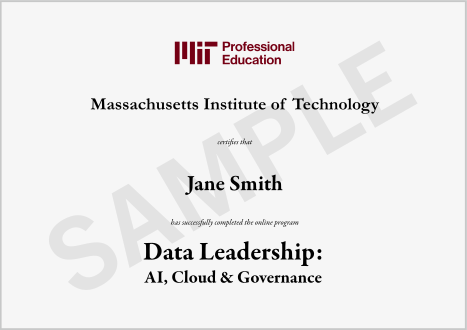
Program Credential: Certificate of Completion
All participants who successfully complete the program will receive an MIT Professional Education Certificate of Completion.
Students in the MIT Professional Education Digital Plus Data Leadership program will also receive MIT Continuing Education Units (CEUs).
To obtain CEUs, complete the accreditation confirmation, which is available at the end of the course. CEUs are calculated for each course based on the number of learning hours.
*The Continuing Education Unit (CEU) is defined as 10 contact hours of ongoing learning and indicates the amount of time devoted to a non-credit, non-degree professional development program.
To understand whether or not these CEUs may be applied toward professional certification, licensing requirements, or other required training or continuing education hours, please consult your training department or licensing authority directly.
Who Should Enroll in the MIT PE Data Leadership Course?
- Senior leaders responsible for shaping data strategy and guiding data-driven initiatives across their organizations. They want to leverage data to improve decision-making and drive business growth.
- Technology leaders seeking to understand modern data systems, cloud technologies, artificial intelligence, and data governance. They want to support digital transformation and business success.
- Senior managers and mid-career executives who want to improve data literacy and strengthen data-driven decision-making. They also want to build practical data leadership skills.
- Professionals in data management roles, including data analytics, data science, machine learning, and data governance. They want to improve data management and create greater value from organizational data.
- Management-level professionals and executives who want to build a data-driven culture across teams and business functions. They seek practical frameworks to leverage data and improve organizational performance.
- Professionals with significant responsibility for business operations, strategy, or technology. They want to harness data, improve reporting, and support informed decisions.
- Organizations with a medium to high number of databases and medium-high data volumes. They want to improve data integration, governance, and utilization across data systems.
- More established organizations and younger start-ups seeking to improve data management and modernize their data capabilities. They want to optimize processes and create business value through data.
- Organizations operating with legacy systems that need to modernize their data structure and cloud capabilities. They want to build scalable data systems that support future growth.
Program prerequisities:
- Basic knowledge of coding is recommended, but not obligatory
- It is recommended that participants speak the same language as those with more technical roles on their teams (IT teams, data scientists, etc.) and be able to identify potential blockers
Discover the experience of our participants

Luis Martinez Pacheco
Business Analytics at Euromadi Iberica SA
In my professional life at the moment what [this course] has allowed me to do is to be able to position myself in certain internal debates that are taking place with a slightly more technical perspective (which until now has always been a closed space for IT) and to be able to ask more complex questions or with a broader vision of the whole process that the company is undergoing.
Data Leadership

Tri Duong
Data Engineer at KBR, Inc.
Through this course, I gained a strong foundation on the limitations and potentials of various tools and frameworks. The course provided me with a solid collection of source references for further research, allowing me to continue learning and exploring even after the course had ended.
Data Leadership

Dharmendra Jain
Director of Operations, Kantar
This course gave me a holistic understanding and knowledge of data-driven initiatives and projects. I learned about the latest technologies for data pipelines, low code/no code, CI/CD, cloud deployment, data compliance, and how I can deploy them.
The course is ideal for anyone who already has some technical knowledge and works at the senior level with the responsibility of leading data-driven initiatives. This incredible learning experience broadened my horizons and equipped me with invaluable skills in data-driven business, leadership, and digital transformation.
Data Leadership
Meet the Course Instructors

Professor John R. Williams’ research focuses on the development and application of computing algorithms in distributed cyberphysical systems. He was director of the Auto-ID Laboratory, where the Internet of Things was invented. He is considered, along with Bill Gates and Larry Ellison, one of the 50 most powerful people in “Computer Networks”.
He is author and coauthor of more than 250 articles in journals and conferences. Professor Williams teaches courses on the basics of programming, modern software development, the architecture of web, cloud and blockchain systems. In addition, he holds a BSc in Physics from Oxford University, an MSc in Physics from UCLA, and a PhD from the University of Swansea.

Dr. Sanchez is the architect of the global network “The Internet of Things” and data analysis platforms for SAP, Ford, Johnson & Johnson, Accenture, Shell, Exxon Mobil and Altria. In cyber security, he has developed cyber-attack impact analyses for the U.S. Department of Defense and a password firewall for the IARPA.
Dr. Abel Sanchez holds a PhD from the Massachusetts Institute of Technology (MIT) and teaches MIT courses in cyber security, engineering, blockchain and data science. He has been involved in developing educational software for Microsoft and establishing the Accenture Technology Academy. He has produced over 150 educational videos, has 10 years of experience with learning management systems and has made deployments in the Americas, Asia and Europe.
Frequently Asked Questions (FAQs)
1. What is the MIT Professional Education Data Leadership: AI, Cloud & Governance course about?
The Data Leadership: AI, Cloud & Governance is an eight-week online course that helps professionals leverage data, cloud technologies, AI, and governance frameworks to drive business success.
2. Do I need a technical background to enroll?
No. A technical background is helpful but not required.
3. Who should enroll in this course?
The course is designed for executives, managers, data professionals, and leaders responsible for data-driven initiatives and digital transformation.
4. What skills will I gain?
You will develop skills in data leadership, data governance, data analytics, cloud technologies, machine learning, and business strategy.
5. Does the course cover artificial intelligence and generative AI?
Yes. Participants explore artificial intelligence, machine learning, generative AI, and their role in modern data systems.
6. Does the course include hands-on learning?
Yes. Participants engage with practical frameworks, real-world applications, case studies, and hands-on learning activities.
7. Does the course cover data governance?
Yes. The course explores data governance, information governance, privacy, cybersecurity, and responsible data management.
8. Will I learn about cloud data platforms?
Yes. Participants explore cloud data architectures, cloud data platforms, data pipelines, and modern data stacks.
9. Does the course include a capstone project?
Yes. Participants complete a hands-on project focused on problem-solving, data leadership, and business impact.
10. Are live sessions included?
Select live online sessions are led by MIT instructors and supported by learning facilitators and industry contributors.
11. Are any taxes applicable to this MIT data leadership course?
Yes. Applicable taxes are calculated and added during checkout based on local regulations.