


START

DURATION
9-12 months
9-12 months

HOURS OF EFFORT
8-10 Hours of Effort per Week
8-10 Hours of Effort per Week

LANGUAGE
English
English

FORMAT
Online
Online

PRICE
APPLICATION FEE
What Is the MIT Professional Education Product Management Program?
The MIT Professional Education Product Management program is designed for professionals seeking to develop innovative products and create measurable business value in an increasingly complex and competitive environment. This Product Management program explores how organizations can integrate technology, design, data, and business strategy to create successful products while enhancing user experience and driving long-term growth.
Through this product manager program, participants learn how to strategically design and develop product families on shared platforms, leverage digital platforms to build customer loyalty, and apply human-centered approaches to product development and decision-making while working with cross-functional teams. By the end of the program, participants will be equipped to align product strategy with business goals, make informed product decisions across the lifecycle, and lead innovation that delivers sustainable competitive advantage.
What Will You Learn in the Product Management Program?
The Product Management program equips professionals with the tools, frameworks, and strategic perspectives needed to address modern product and innovation challenges. Through a multidisciplinary curriculum, participants explore design thinking with MITdesignX, product family architecture, digital platforms, two-sided markets, and data-driven approaches for measuring, predicting, and influencing technological innovation. The learning journey includes:
Course 1. Designing Scalable Solutions: Driving High-Impact Innovation
- Identify – Introduction to the Course and The Method
- Discover – Needs and Stakeholder Analysis
- Define – Visualize Change and Prepare Solutions
- Commit – Value Creator and User Experience
- Create – Prototype A Solution and Design a Business Model
- Develop – Organizational Design and Team Dynamic
- Deploy/Implement – Launch and Scale the Solution
- Scaling – Beyond the Course
- Deploy II: Scaling Through Storytelling
Course 2. Designing Product Families: From Strategy to Implementation
- Fundamental Principles of Platform-Based Manufacturing
- The Advantages of Platforms and Implementation Strategy
- Product and Platform Architecture
- Platform Analysis
- Platform Design
- Platform Planning
- Industrial Platforms and Bilateral Markets
- Two-sided Markets and Industrial Platforms
Course 3. Digital Platforms: Designing Two-Sided Markets from APIs to Feature Roadmaps
- Logistics and Orientation
- Industry Platforms: The Basics
- What Does a Successful Digital Ecosystem Look Like?
- Initiation and First Transactions
- Architecture of Digital Platforms
- Growing the Platform: Ensuring Quality and Robustness
- Growing the Platform: Users and Partners
- Platform Dynamics
Course 4. Forecasting Technology and Innovation: Using Data for Strategic Advantage
- Understand how large data sets can be used to gain insights into the dynamics of technological innovation
- Learn how to compare the rates of progress of various technologies
- Explore the state of the art in theories of technological innovation and their application
- Discover how to apply data analysis to guide technology investment
- Discover how to apply data analysis to guide design decisions
- Gain insights into how to improve decision-making
Course 5. Applied Agentic AI for Organizational Transformation
- Understand the core concepts behind generative and agentic AI
- Explore the evolution of AI agents and emerging AI platforms
- Learn how AI agents integrate with existing digital platforms
- Identify agent risks, disinformation, and systemic impacts
- Discover how AI agents transform key business functions
- Learn how to scale AI initiatives from pilots to real-world deployment
- Build effective governance, compliance, and agent testing strategies
- Develop a strategic roadmap for leading in the agentic AI era
What Core Competencies Will You Develop as a Product Manager from this Program?
1.
Strategic alignment: Align product strategy with organizational goals to guide feature decisions and assess performance.
2.
Product innovation: Design and develop differentiated products that build loyal customer bases through thoughtful design, data-driven insights, and intelligent capabilities.
3.
Portfolio design: Apply methods and tools to design product families and prioritize solutions for complex, system-level challenges.
4.
Data intelligence: Leverage data, analytics, and AI-enabled tools to identify market opportunities and enhance decision-making and product planning.
5.
Cross-functional leadership: Lead transdisciplinary problem-solving teams effectively by fostering collaboration, aligning goals, and integrating diverse expertise to drive innovation.
6.
Product development: Master key principles of product creation including manufacturing strategy, composition, and design evolution across the product lifecycle.
7.
AI integration: Utilize machine learning, generative AI, and agentic AI to support complex business decisions, enable intelligent automation, and drive scalable product impact.
Program Credential: Certificate of Completion
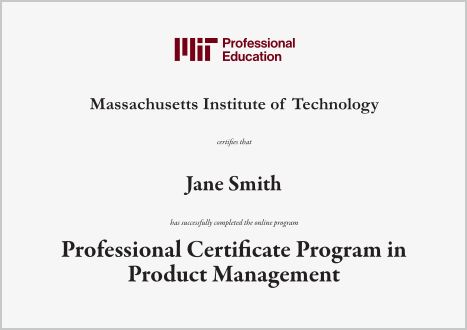
All the participants who successfully complete the Product Management program will receive a Certificate of Completion from MIT Professional Education. Furthermore, the participants who complete the program receive MIT Continuing Education Units (CEUs)*.
To obtain CEUs, participants must complete the accreditation confirmation available at the end of each course. CEUs are awarded based on the number of learning hours completed.
* The Continuing Education Unit (CEU) is defined as 10 contact hours of ongoing learning to indicate the amount of time they have devoted to a non-credit/non-degree professional development program.
To understand whether or not these CEUs may be applied toward professional certification, licensing requirements, or other required training or continuing education hours, please consult your training department or licensing authority directly.
Benefits of Joining the Professional Alumni Community
MIT Professional Education offers a number of benefits for participants who successfully complete our Professional Certificate Programs:
- Digital Professional Certificate and MIT CEUs*.
- 15% benefit for online programs and short-duration, in-person programs offered by MIT Professional Education.
- 20% benefit for all DPP programs
- Invitation to a Certificate Award Ceremony at MIT’s campus in Cambridge, Massachusetts, where participants will receive a physical certificate.
- Access to the virtual campus for 2 years after program completion.
- Exclusive announcements of new courses, programs, and events.
- Exclusive access to the MIT Professional Education Alumni LinkedIn group, connecting you with a global network of fellow MIT Professional Education alumni.
Who Is This Product Management Program For?
This program is ideal for a range of executives from various industries, with a background in product management and technology, including:
- Directors and senior managers responsible for product management, product engineering, innovation, or marketing.
- Owners or CEOs of tech startups who need a clear roadmap to launch and manage their projects effectively.
- Current product leaders and aspiring C-suite executives who want to keep up to date on trends in product management and innovation.
- Professionals with strong leadership skills who want to have a powerful impact on the success of their organization’s creative processes.
- Senior executives looking to align product strategy with business strategy and understand the implications of technology for the product portfolio.
Meet the instructors of this program
*Listed in alphabetical order
Dr. Bruce Cameron is director of the System Architecture Lab at MIT and co-founder of the consulting firm Technology Strategy Partners. His areas of research include technology strategy, system architecture and product platform management.

Olivier de Weck is the Apollo Program Professor of Astronautics and Engineering Systems at the Massachusetts Institute of Technology (MIT). He earned degrees in Industrial Engineering from ETH Zurich and Aerospace Systems from MIT where he is the faculty director of the Engineering Systems Laboratory.
His main research is in Systems Engineering with a focus on how complex technological systems are designed and how they evolve over time. He has authored or co-authored over 400 publications for which he has been recognized with twelve best paper awards since 2004.
He is a Fellow of INCOSE and a Fellow of AIAA where he is Editor-in-Chief of the Journal of Spacecraft and Rockets. As a former Senior Vice President of Technology Planning and Roadmapping at Airbus he was responsible for roadmapping a $1-billion R&D portfolio for the world’s largest aircraft manufacturer.
His passion is to improve life on our home planet Earth through research and education, while paving the way for humanity’s future off-world settlements.

As a member of a team of entrepreneurs that created and scaled two global life science companies her professional career has been focused on organizational design for high-growth companies. As a venture designer, she works in parallel in industry and academia with teams of people from around the world to build companies, brands, experiences, academic programs, processes, and organizational structures designed to improve business results and workplace wellbeing. Applying the lens of design with a concern for human needs to solve complex problems has been a focal point of her work.
PROGRAMS: Beyond IoT · Smart Manufacturing

Gilad Rosenzweig is an architect and urban planner with vast experience in community development, urban tech, and design. As Executive Director of MITDesignX, the venture accelerator of MIT’s School of Architecture and Planning, he is laying the groundwork for new technology to improve the comfort and efficiency of buildings, places, and cities. Before MITDesignX, Gilad created Smarter in the City, an accelerator for high-tech startups in underrepresented communities. He is a graduate of MIT’s Department of Urban Studies and Planning and the Bartlett School of Architecture in London.

Dr. Sanchez is the architect of the global network “The Internet of Things” and data analysis platforms for SAP, Ford, Johnson & Johnson, Accenture, Shell, Exxon Mobil and Altria. In cyber security, he has developed cyber-attack impact analyses for the U.S. Department of Defense and a password firewall for the IARPA.
Dr. Abel Sanchez holds a PhD from the Massachusetts Institute of Technology (MIT) and teaches MIT courses in cyber security, engineering, blockchain and data science. He has been involved in developing educational software for Microsoft and establishing the Accenture Technology Academy. He has produced over 150 educational videos, has 10 years of experience with learning management systems and has made deployments in the Americas, Asia and Europe.

Timothy W. Simpson is a Professor of Mechanical Engineering and Industrial Engineering at the Pennsylvania State University. He holds affiliate appointments in Engineering Design and the College of Information Sciences & Technology. His research interests include product family design and platform-based product development, multidisciplinary design optimization, trade space exploration, and additive manufacturing. He has over 250 publications in peer-reviewed journals and conference proceedings and he is the lead editor on two books, Product Platform and Product Family Design: Methods & Applications (2005) and Advances in Product Family and Product Platform Design: Methods & Applications (2013). His research has been supported by a variety of federal and state agencies, including NSF, ONR, DARPA, EDA, and DCED, as well as numerous companies, ranging from startups to multi-national corporations. He has worked with over 30 different companies to apply his research methods to improve their product lines and product development practices, and he helped establish and manage the Product Platforms Group on LinkedIn.

Jessika Trancik is a professor in the Institute for Data, Systems, and Society at the Massachusetts Institute of Technology. Her research examines the impacts of technologies and the reasons behind technological change. She has developed theory and predictive models to understand why some technologies improve faster than others, and what technology features enable rapid innovation. Trancik has developed models for forecasting technological change, which inform engineering design, public policy, and investment portfolios. Several of her theories and models have been applied to new and developing energy technologies, such as solar energy and batteries, and to electricity and transportation systems. Her models have also been used to inform government innovation policy, and applied in diverse industries, including finance, healthcare, manufacturing, software, and consumer products. Her work has been published in journals such as Nature, Proceedings of the National Academy of Sciences, Nature Energy, Nature Climate Change, and Environmental Science and Technology, and has been featured by news outlets such as the New York Times, Washington Post, Financial Times, and NPR.
Three blurbs:
- Professor Trancik received her B.S. from Cornell University and her Ph.D. from the University of Oxford as a Rhodes Scholar.
- She has developed theory and predictive models to understand why some technologies improve faster than others, and what technology features enable rapid innovation.
- Her models have also been used to inform government innovation policy, and applied in diverse industries, including finance, healthcare, manufacturing, software, and consumer products.

Professor John R. Williams’ research focuses on the development and application of computing algorithms in distributed cyberphysical systems. He was director of the Auto-ID Laboratory, where the Internet of Things was invented. He is considered, along with Bill Gates and Larry Ellison, one of the 50 most powerful people in “Computer Networks”.
He is author and coauthor of more than 250 articles in journals and conferences. Professor Williams teaches courses on the basics of programming, modern software development, the architecture of web, cloud and blockchain systems. In addition, he holds a BSc in Physics from Oxford University, an MSc in Physics from UCLA, and a PhD from the University of Swansea.
Application Process
1
Complete the application form and pay the non-refundable fee.
2
The admissions committee will evaluate your application.
3
Once you are admitted in the program, you’ll have 72 hours to pay the enrollment fee and reserve your place.
FAQs
1. How does effective product management contribute to business success?
Effective product management helps organizations align customer needs, business goals, and technology to create successful product offerings and drive long-term growth. This program equips participants with practical skills and strategic frameworks to strengthen the product management process, make informed product decisions, and deliver product success.
2. How can the Product Management program help professionals build effective product management skills?
The program helps participants build skills in product strategy, customer experience, project management, product lifecycle management, and data-driven decision-making to lead products successfully from concept to launch.
3. How does the Product Management program develop cross-functional leadership capabilities?
Participants learn how to align stakeholders and collaborate effectively across product, design, engineering, marketing, and business teams while integrating marketing strategies into product planning and execution.
4. How can the Product Management program help improve product offerings?
The program provides frameworks for identifying customer needs, evaluating market opportunities, and applying the product management process to develop innovative product offerings that create value for both customers and organizations.
5. Who should enroll in the Product Management program?
The program is designed for product managers, business leaders, entrepreneurs, innovation professionals, project management professionals, and aspiring product managers seeking to build skills and strengthen their product leadership capabilities.