


START

DURATION
9-12 months
9-12 months

HOURS OF EFFORT
8-10 Hours of Effort per Week
8-10 Hours of Effort per Week

LANGUAGE
English
English

FORMAT
Online
Online

PRICE
APPLICATION FEE
Overview: Digital Transformation in the AI Age
The Digital Transformation in the AI Age professional certificate program from MIT Professional Education equips leaders with the knowledge, frameworks, and strategic perspective needed to drive transformation in an increasingly digital and AI-powered business environment. Through a nine- to twelve-month learning journey that includes case studies, live online sessions, and participants dive into the technologies shaping the future of business, including artificial intelligence, cloud computing, cybersecurity, blockchain, and the Internet of Things.
By the end of this digital transformation program, participants will be prepared to leverage technology as a catalyst for growth, operational excellence, and long-term competitive advantage.
What Will You Learn in the Digital Transformation in the AI Age Program?
This nine- to twelve-month Digital Transformation in the AI Age professional certificate program combines leadership development, emerging technologies, and AI-driven innovation to help professionals lead transformation initiatives across organizations. Through five complementary courses, participants learn how to align technology with business strategy, build high-performing teams, and create sustainable competitive advantage in an increasingly digital world.
Course 1. Cultural Awareness
- Understand culture and its impact on language and communication
- Recognize key cultural differences in professional environments
- Navigate business effectively in multicultural settings
- Avoid common cross-cultural communication and etiquette pitfalls
Course 2. Innovative Leadership: Cultivating Impactful Culture
- Understand how leadership drives innovation and organizational success
- Assess and strengthen your core leadership capabilities
- Build and communicate a clear, shared vision to align teams
- Apply leadership skills to real-world challenges through an integrative project
Course 3. Applied Agentic AI for Organizational Transformation
- Understand the fundamentals of generative and agentic AI and their business applications
- Design AI-driven strategies using cloud, APIs, and enterprise platforms
- Build hands-on skills in AI-powered content creation across formats
- Identify and manage AI risks, including ethics, compliance, and misinformation
- Bridge the gap between AI capabilities and business outcomes
- Navigate AI ethics and regulatory challenges in real-world contexts
Course 4. Applied AI for Digital Transformation
- Understand generative and agentic AI and their real-world applications
- Design AI-driven strategies using cloud, APIs, and enterprise tools
- Build hands-on skills in multi-format AI content creation
- Manage AI risks, including ethics, compliance, and misinformation
- Connect AI capabilities to business outcomes without technical expertise
- Navigate AI ethics and regulatory challenges effectively
Course 5. AI-Driven Leadership
- Understand digital transformation in the age of AI
- Decode AI technologies and their business implications
- Explore IoT and digital twins in connected ecosystems
- Collaborate effectively with AI and autonomous systems
- Lead and drive transformational change across organizations
- Build capabilities for sustained success in a digital world
- Anticipate emerging technologies and future trends
- Co-create future-ready strategies and innovation pathways
AI Applications and Technologies Covered in the Program
The Digital Transformation in the AI Age program equips participants with the tools, frameworks, and strategic perspective needed to lead technology-enabled transformation.

Generative AI
Learn how Generative AI can automate workflows, enhance productivity, support decision-making, and create business value across a range of organizational functions.

Agentic AI
Understand how Agentic AI can support AI-driven transformation, enable practical innovation, and help organizations create measurable business value.

Artificial Intelligence Strategy
Explore how AI can be integrated into organizational strategy, innovation initiatives, business models, and digital transformation efforts.

Cloud Computing
Examine the role of cloud technologies in supporting digital transformation, enabling scalability, and driving enterprise innovation.

Blockchain and Emerging Technologies
Understand how technologies such as blockchain, IoT, and other emerging digital technologies are reshaping industries and creating new opportunities.

Cybersecurity
Explore key technology risks, security considerations, and governance challenges associated with AI adoption and digital transformation initiatives.
In nine- to-twelve months, participants gain a comprehensive understanding of the technologies, leadership capabilities, and strategic frameworks required to lead successful digital transformation initiatives in the age of AI.
DISCOVER THE COURSE CONTENT
What Skills Will You Learn in This Digital Transformation in the AI Age Program?
1.
Lead Digital Transformation: Align technology, people, and strategy to drive successful transformation initiatives.
2.
Leverage AI for Business Growth: Understand how Artificial Intelligence, Generative AI, and Agentic AI can create business value and competitive advantage.
3.
Master Emerging Technologies: Explore cloud computing, cybersecurity, blockchain, IoT, and other technologies shaping the future of business.
4.
Drive Innovation Across Organizations: Build the leadership and collaboration skills needed to foster innovation and lead diverse teams.
5.
Turn Technology into Business Impact: Evaluate emerging technologies and translate innovation into measurable outcomes.
6.
Lead Responsible AI Adoption: Navigate AI governance, compliance, risk management, and ethical considerations.
7.
Build Future-Ready Leadership Skills: Develop the adaptability and strategic mindset needed to lead in a rapidly evolving digital world.
Why Choose the MIT Professional Education
Digital Transformation in the AI Age Program?
Lead Digital Transformation
Develop the leadership capabilities needed to guide organizations through technological change, innovation, and business transformation.
Build AI and Technology Expertise
Understand how AI, Generative AI, Agentic AI, Cloud Computing, Blockchain, IoT, and Cybersecurity are reshaping industries and business models.
Drive Innovation and Growth
Learn to identify opportunities, evaluate emerging technologies, and create strategies that deliver measurable business impact.
Strengthen Organizational Agility
Build resilient, high-performing teams that can adapt to evolving technologies, market shifts, and global business challenges.
Apply AI in Real-World Business Contexts
Explore practical applications of AI-driven technologies and learn how to integrate them into operations, workflows, and decision-making.
Lead Across Diverse Business Environments
Develop the cultural awareness and leadership skills needed to collaborate effectively in global and multicultural organizations.
Create Long-Term Competitive Advantage
Combine technology, leadership, and innovation frameworks to improve efficiency, engagement, and organizational performance.
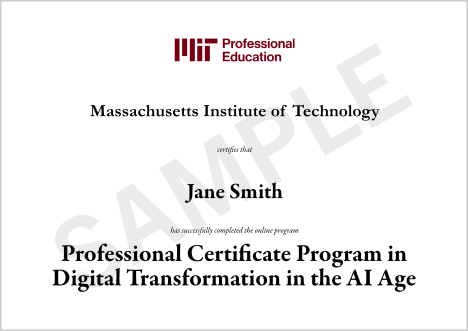
Program Credential: Certificate of Completion
Participants who successfully complete the Digital Transformation in the AI Age professional certificate program receive an MIT Professional Education Certificate of Completion and MIT Continuing Education Units (CEUs).
To obtain CEUs, participants must complete the accreditation confirmation available at the end of each course. CEUs are awarded based on the number of learning hours completed.
* The Continuing Education Unit (CEU) is defined as 10 contact hours of ongoing learning to indicate the amount of time they have devoted to a non-credit/non-degree professional development program.
To understand whether or not these CEUs may be applied toward professional certification, licensing requirements, or other required training or continuing education hours, please consult your training department or licensing authority directly.
Benefits of Joining the Professional Alumni Community
MIT Professional Education offers a number of benefits for participants who successfully complete our Professional Certificate Programs:
- Digital Professional Certificate and MIT CEUs*.
- 15% benefit for online programs and short-duration, in-person programs offered by MIT Professional Education.
- 20% benefit for all DPP programs
- Invitation to a Certificate Award Ceremony at MIT’s campus in Cambridge, Massachusetts, where participants will receive a physical certificate.
- Access to the virtual campus for 2 years after program completion.
- Exclusive announcements of new courses, programs, and events.
- Exclusive access to the MIT Professional Education Alumni LinkedIn group, connecting you with a global network of fellow MIT Professional Education alumni.
Program Instructors: Digital Transformation in the AI Age
Learn from MIT instructors and industry experts with deep experience in leadership, innovation, digital transformation, emerging technologies, and AI-driven business strategy. Throughout the Digital Transformation in the AI Age program, participants gain practical insights from instructors who have helped organizations navigate technological change, drive innovation, and build future-ready businesses.
Listed in alphabetical order

Bhaskar Pant is the executive director of MIT Professional education, the branch of MIT that provides technology professionals access to MIT knowledge. Under his direction, the MIT Professional Education offering has grown considerably, as have corporate relationships and its global reach, as professionals from more than 120 different countries participate in the classroom, internationals and, recently, also in those launched in online and mixed formats. The courses, which cover such cutting-edge areas as big data, artificial intelligence, and the Internet of Things (IoT), combined with other professional development courses in the fields of innovation and entrepreneurship, have benefited thousands of professionals worldwide.
Mr. Pant was part of the “The Future of Education at MIT” team, created by the MIT President, and contributed specifically to the work of the subcommittee that was responsible for “opening the doors of MIT to the world”. Building on Mr. Pant’s initiative, whose objective was to expand globally, MIT Professional Education offers short programs in an increasing number of regions in Asia, Latin America, the Middle East, and Europe. Prior to joining MIT, Mr. Pant held important leadership positions in education and corporate companies around the world.
PROGRAMS: Cultural Awareness

Dr. Sanchez is the architect of the global network “The Internet of Things” and data analysis platforms for SAP, Ford, Johnson & Johnson, Accenture, Shell, Exxon Mobil and Altria. In cyber security, he has developed cyber-attack impact analyses for the U.S. Department of Defense and a password firewall for the IARPA.
Dr. Abel Sanchez holds a PhD from the Massachusetts Institute of Technology (MIT) and teaches MIT courses in cyber security, engineering, blockchain and data science. He has been involved in developing educational software for Microsoft and establishing the Accenture Technology Academy. He has produced over 150 educational videos, has 10 years of experience with learning management systems and has made deployments in the Americas, Asia and Europe.

David Niño is a Senior Lecturer in MIT’s Daniel J. Riccio Graduate Program in Engineering Leadership. He had served in this role since 2015 when he launched this program to provide academic leadership education for MIT graduate students in engineering and other disciplines. Under his leadership, the program has grown from one graduate class to a variety of highly-rated academic courses and workshops that educate over 200 graduate students annually. David received a School of Engineering “Infinite Mile Award” for his work in establishing this program, which received a $10 million gift of support in 2022.
David consults with technology executives on topics related to developing leadership among engineers, researchers, and other technical experts. He has published on organizational culture, ethics, engineering leadership, and developing management and leadership skills. David holds a Ph.D. in Management from the University of Texas at Austin, where he earned his B.A., B.B.A., and M.A. degrees. He lives in Weston, Massachusetts, with his wife and three children.
David consults with technology executives on topics related to developing leadership among engineers, researchers, and other technical experts. He has published on organizational culture, ethics, engineering leadership, and developing management and leadership skills. David holds a Ph.D. in Management from the University of Texas at Austin, where he earned his B.A., B.B.A., and M.A. degrees. He lives in Weston, Massachusetts, with his wife and three children.

Professor John R. Williams’ research focuses on the development and application of computing algorithms in distributed cyberphysical systems. He was director of the Auto-ID Laboratory, where the Internet of Things was invented. He is considered, along with Bill Gates and Larry Ellison, one of the 50 most powerful people in “Computer Networks”.
He is author and coauthor of more than 250 articles in journals and conferences. Professor Williams teaches courses on the basics of programming, modern software development, the architecture of web, cloud and blockchain systems. In addition, he holds a BSc in Physics from Oxford University, an MSc in Physics from UCLA, and a PhD from the University of Swansea.

Hear from past participants of the program

HUGO LIZARAZO JARA
IT Manager Center of Excellence at Banco de Bogotá
I have been surprised by the way this knowledge has developed in participants from such diverse professions. It is a very successful approach by MIT Professional Education to spread this knowledge in such an effective, practical, and concrete way.
Professional Certificate Program in Digital Transformation

VANESSA VILCHEZ
After Sales Systems Coordinator at Entel
Everything about this professional certificate program is a true learning experience. The knowledge I have been able to learn has been quite revealing and is not only helping me in my professional life but also in my personal life.
Professional Certificate Program in Digital Transformation

PATRICIO MAGUIRE
Associate Director at Turner & Townsend
This program far exceeded my expectations. It is an introspective journey of great impact, where you learn a lot through interaction with your peers and personal reflection. A must for the development of leaders in all types of organizations.
Professional Certificate Program in Digital Transformation
How Does the Application Process Work?
1
Submit your application
Complete the application form and pay the non-refundable application fee.
2
Application review
Our admissions team will review your application and evaluate your eligibility for the program.
3
Confirm your enrollment
If admitted, you will have 72 hours to pay the enrollment fee and secure your place in the Digital Transformation in the AI Age program.
FAQs
1. What is the Digital Transformation in the AI Age program?
The Digital Transformation in the AI Age Professional Certificate Program from MIT Professional Education helps leaders understand emerging technologies, strengthen leadership capabilities, and drive successful transformation initiatives. Participants learn how to create business value through innovation, AI, and technology-enabled change.
2. Who should enroll in this MIT Professional Education digital transformation program?
This digital transformation program is designed for executives, managers, technology leaders, entrepreneurs, and professionals who want to lead innovation, navigate disruption, and build future-ready organizations.
3. Is this digital transformation course suitable for non-technical professionals?
Yes. This digital transformation course is designed for professionals from diverse backgrounds. No programming or technical expertise is required. The program focuses on leadership, strategy, innovation, and the business applications of emerging technologies.
4. What technologies will I learn about in this professional certificate program?
Participants explore technologies shaping the future of business, including Artificial Intelligence, Generative AI, Agentic AI, Cloud Computing, Blockchain, the Internet of Things (IoT), and Cybersecurity, along with the leadership frameworks needed to implement them effectively.
5. How much time should I expect to dedicate to the program?
The Digital Transformation in the AI Age Professional Certificate Program is delivered over nine- to-twelve months in a flexible online format. Participants should expect to dedicate approximately 8–10 hours per week to coursework and learning activities.
6. What makes this an AI digital transformation course?
This AI digital transformation course combines leadership, emerging technologies, and practical business applications of AI. Participants learn how to leverage AI to drive innovation, improve decision-making, enhance operational efficiency, and create sustainable competitive advantage.
7. Is a certificate from MIT worth it?
For professionals seeking to lead digital transformation and AI-driven innovation, an MIT Professional Education certificate offers practical, industry-relevant learning from MIT instructors. Participants gain in-demand skills, strategic frameworks, and an MIT Professional Education Certificate of Completion that demonstrates their commitment to professional growth.