


START
END

DURATION
8 weeks
8 weeks

HOURS OF EFFORT
4-5 Hours of Effort per Week
4-5 Hours of Effort per Week

LANGUAGE
English
English

FORMAT
Live Online
Live Online

PRICE
Artificial Intelligence Beyond Hype and Assumption
AI is increasingly shaping how organizations operate and compete, yet much of its adoption is influenced by incomplete understanding and broad assumptions about its potential. This often results in initiatives that lack clarity, struggle to scale, or fail to deliver meaningful value in real business contexts.
To engage with artificial intelligence effectively, organizations must move beyond surface-level narratives and examine how these systems function, where they perform reliably, and where their limitations introduce risk. As artificial intelligence becomes embedded within enterprise systems and workflows, it requires a structured and disciplined approach that is grounded in practical understanding and informed decision-making.
A Live Online Course on Evaluating and Applying Artificial Intelligence in Organizations
MIT Professional Education’s live online course Leading AI Strategy: From Hype to Enterprise Reality presents a structured understanding of artificial intelligence from a strategic and operational perspective. The course examines how AI systems function at a high level, how they are deployed within organizations, and how they influence decision-making, workflows, and business outcomes. It draws on real-world cases and a systems-oriented approach to help participants evaluate AI beyond surface-level narratives.
The course builds a foundation for assessing artificial intelligence through the lenses of capability, cost, risk, and organizational impact. Participants explore how AI integrates into enterprise systems, how it shapes roles and accountability, and how it can be applied in ways that align with business priorities. Through this approach, the course enables a clear and disciplined understanding of artificial intelligence in practical business contexts.
The skills you will develop
1.
Understand what AI is, how it works at a high level, and where its limits lie
2.
Assess what AI systems can and cannot do in real-world contexts
3.
Evaluate how AI systems perform in real operating conditions
4.
Identify failure points, risks, and implications of overreliance on AI systems
5.
Interpret cost structures, value creation, and AI investment dynamics
6.
Understand how AI is incorporated into business systems, workflows, and roles
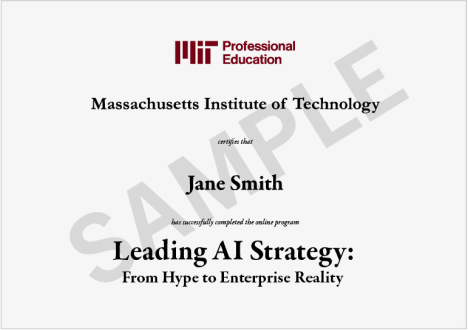
In addition, you will receive a Certificate of Completion
All the participants who successfully complete the online course Leading AI Strategy: From Hype to Enterprise Reality will receive an MIT Professional Education Certificate of Completion. Furthermore, participants will receive (enter) MIT Continuing Education Units (CEUs)*.
To obtain CEUs, complete the accreditation confirmation, which is available at the end of the course. CEUs are calculated for each course based on the number of learning hours.
btain CEUs, complete the accreditation confirmation, which is available at the end of the course. CEUs are calculated for each course based on the number of learning hours.
* The Continuing Education Unit (CEU) is defined as 10 contact hours of ongoing learning to indicate the amount of time they have devoted to a non-credit/non-degree professional development program.
To understand whether or not these CEUs may be applied toward professional certification, licensing requirements, or other required training or continuing education hours, please consult your training department or licensing authority directly.
Participant Profile
This course is designed for professionals responsible for making real decisions about AI, where cost, risk, accountability, and organizational impact matter.
- Mid- to senior-level leaders and functional heads looking to understand how AI influences corporate strategy, competitive dynamics, and enterprise design, with responsibility for AI initiatives that must perform under real operational, legal, and economic constraints.
- C-suite and business unit leaders navigating AI-driven disruption and building long-term strategic advantage across platforms, ecosystems, and intelligent systems.
- Innovation, strategy, and transformation leaders aiming to move beyond pilots and drive enterprise-wide adoption of AI initiatives.
- Senior consultants and advisors supporting organizations on AI strategy, operating model redesign, governance, and responsible transformation.
- Senior technology and data leaders responsible for integrating AI into complex enterprise systems while managing reliability, governance, and failure risk.
Meet your Instructor

Sanjay Sarma is the Fred Fort Flowers (1941) and Daniel Fort Flowers (1941) Professor of Mechanical Engineering at MIT. He was the President and CEO of the Asia School of Business until May 2025, and for 10 years previously Vice President and Dean for Open Learning at MIT. He previously led the team that helped establish the Singapore University of Technology and Design. He co-founded the Auto-ID Center at MIT and developed many of the key technologies behind modern UHF RFID standards now used worldwide. He was also the founder and CTO of OATSystems, which was acquired by Checkpoint Systems (NYSE: CKP) in 2008.
He serves on the boards of Aclara Resources (TSX:ARA), Rekor Systems (NASDAQ:REKR) and several startup companies. Sarma received his Bachelors from the Indian Institute of Technology, his Masters from Carnegie Mellon University and his PhD from the University of California at Berkeley. Sarma also worked at Schlumberger Oilfield Services in Aberdeen, UK, and at the Lawrence Berkeley Laboratories in Berkeley, California. He has authored over 200 papers in sensing, AI, AR, IoT, RFID, manufacturing and other fields. He is the author of several books including Grasp: the Science Transforming How We Learn.